
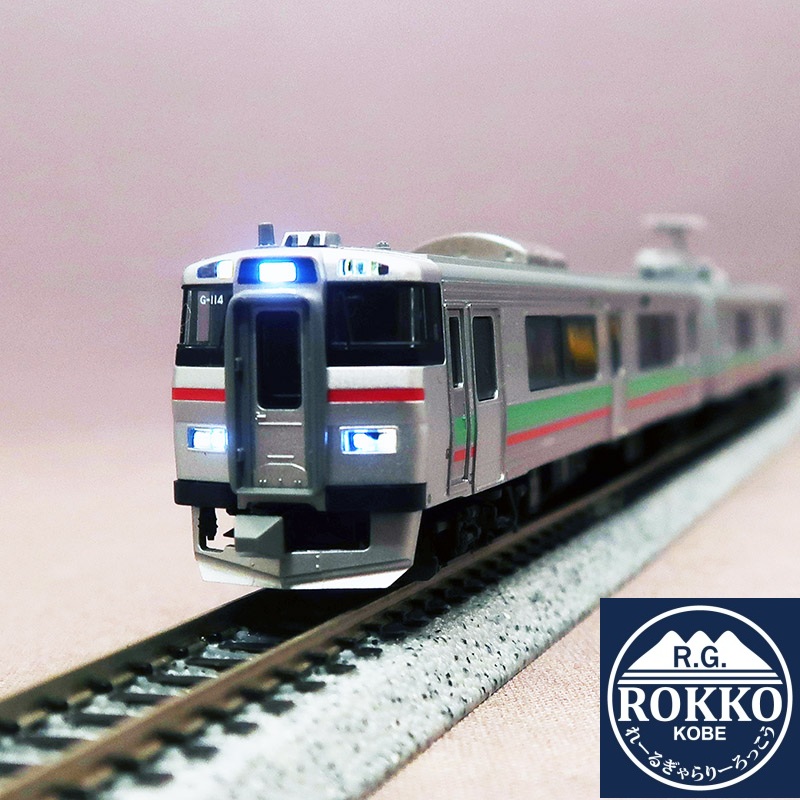
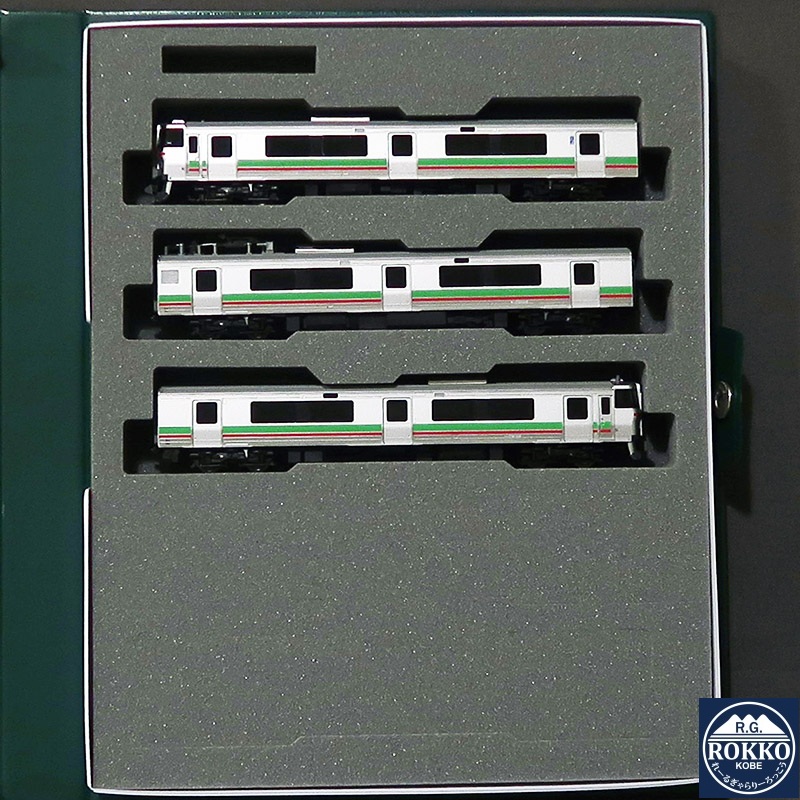
(10-2240) JR 731 Series Ishikari Liner 3Cars ※Equipped with a new slotless motor
¥10,500JPY
SKU: KATO 10-2240
Package Volume: 630.00
Related Category
- KATO > N Scale > Electric Cars

ItemNumber 10-2240
JR 731 Series Ishikari Liner
3 cars Set
information
●The 731 series is an AC commuter electric train introduced by JR Hokkaido in 1997. Its key features include a stainless-steel body that is slightly longer than standard 21-meter, three-door commuter trains, and an interior layout—a first for Hokkaido—that eliminates vestibule partitions in favor of continuous longitudinal seating. In recent years, the series has undergone modifications such as the installation of single-arm pantographs, the removal of automatic gangway connection systems, and the updating of major equipment.
The KiHa 201 series is a commuter diesel train introduced by JR Hokkaido in 1997. It adopts an electric-train-like configuration—featuring a three-car formation that includes an intermediate car without a cab—and is powered by two 450-horsepower engines per car, enabling a top speed of 130 km/h. It is also equipped with a car-body tilting system designed to improve performance on curves (though this system is currently deactivated). Both the 731 and KiHa 201 series are capable of coordinated coupled operation; while the 731 series lacks the tilting mechanism, it shares the same tapered upper-body cross-section design as the KiHa 201 series.
The 731 series operates on the Hakodate Main Line (Otaru–Sapporo–Takikawa), the Chitose and Muroran Main Lines (Sapporo–New Chitose Airport/Tomakomai), and the Sassho Line/JR Gakuentoshi Line (Sapporo–Hokkaido Medical University); until recently, it was also used for "Ishikari Liner" services. The KiHa 201 series operates on the Hakodate Main Line (Rankoshi–Otaru–Sapporo–Iwamizawa), with coordinated coupled operations involving both the 731 and KiHa 201 series taking place between Otaru and Sapporo.
◆ Equipped with a newly developed slotless motor as standard
By adopting a newly developed slotless motor, it demonstrates smoother and quieter running performance than existing motors.
JR 731 Series Ishikari Liner
3 cars Set
information
●The 731 series is an AC commuter electric train introduced by JR Hokkaido in 1997. Its key features include a stainless-steel body that is slightly longer than standard 21-meter, three-door commuter trains, and an interior layout—a first for Hokkaido—that eliminates vestibule partitions in favor of continuous longitudinal seating. In recent years, the series has undergone modifications such as the installation of single-arm pantographs, the removal of automatic gangway connection systems, and the updating of major equipment.
The KiHa 201 series is a commuter diesel train introduced by JR Hokkaido in 1997. It adopts an electric-train-like configuration—featuring a three-car formation that includes an intermediate car without a cab—and is powered by two 450-horsepower engines per car, enabling a top speed of 130 km/h. It is also equipped with a car-body tilting system designed to improve performance on curves (though this system is currently deactivated). Both the 731 and KiHa 201 series are capable of coordinated coupled operation; while the 731 series lacks the tilting mechanism, it shares the same tapered upper-body cross-section design as the KiHa 201 series.
The 731 series operates on the Hakodate Main Line (Otaru–Sapporo–Takikawa), the Chitose and Muroran Main Lines (Sapporo–New Chitose Airport/Tomakomai), and the Sassho Line/JR Gakuentoshi Line (Sapporo–Hokkaido Medical University); until recently, it was also used for "Ishikari Liner" services. The KiHa 201 series operates on the Hakodate Main Line (Rankoshi–Otaru–Sapporo–Iwamizawa), with coordinated coupled operations involving both the 731 and KiHa 201 series taking place between Otaru and Sapporo.
◆ Equipped with a newly developed slotless motor as standard
By adopting a newly developed slotless motor, it demonstrates smoother and quieter running performance than existing motors.