
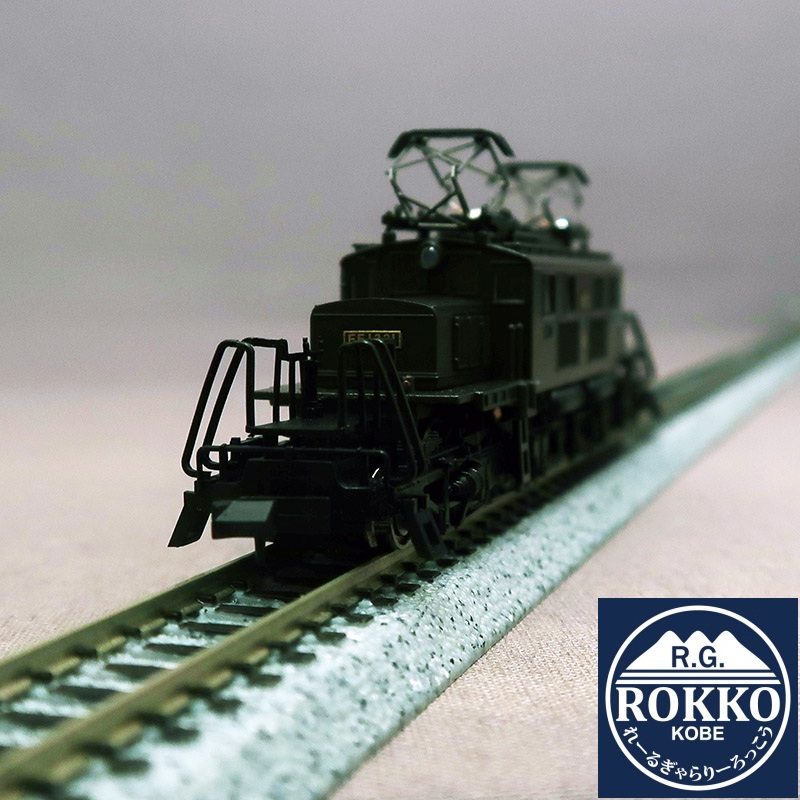
(A2234) JNR EF13-31 first renovation
¥12,420JPY
SKU: MicroAce A2234
Package Volume: 220.00

ItemNumber A2234
JNR EF13-31 first renovation
information
During World War II, amidst shortages of all kinds of supplies, vehicles based on a "wartime design" that combined material conservation with a simplified shape that could be manufactured by unskilled workers were created. The EF13 was a new electric locomotive that appeared in 1944 to cope with the ever-increasing volume of freight transport. To conserve steel, the body was shortened to cover only the minimum necessary areas and the plate thickness was reduced. Small equipment was housed in the bonnet sections at both ends, and its most distinctive external feature was its unique convex body shape, unlike any other standard electric locomotive. Thorough simplification was achieved by omitting the air valve system by installing two sets of sandboxes and piping for each driving wheel, adopting the PS13 pantograph for electric trains, and omitting the deck sections at both ends. As a result of this thorough simplification, the locomotive lacked weight, so 16.4 tons of concrete were added as dead weight inside the frame and equipment room. Despite being called a wartime model, only seven units were completed by the end of the war due to material shortages, air raids, evacuations, and the conscription of workers, with the remaining 24 units being completed sequentially by 1947. Unit 11 was manufactured by Kawasaki Heavy Industries on October 26, 1944, and official photographs from the time of its completion show that the ventilators on the side of the body were horizontal. Due to excessive simplification, such as the omission of high-speed circuit breakers, electric shock accidents and malfunctions occurred frequently, and as a result, modifications were made to the equipment to make it more practical from around 1948. The pantograph was replaced with a PS14, the decks at the front and rear ends were refurbished, and the sandboxes on the main bogies were refurbished, giving it a completely new look. It was reborn as a freight electric locomotive that could stably exhibit performance comparable to the pre-war EF12, and played an active role in supporting post-war reconstruction.
JNR EF13-31 first renovation
information
During World War II, amidst shortages of all kinds of supplies, vehicles based on a "wartime design" that combined material conservation with a simplified shape that could be manufactured by unskilled workers were created. The EF13 was a new electric locomotive that appeared in 1944 to cope with the ever-increasing volume of freight transport. To conserve steel, the body was shortened to cover only the minimum necessary areas and the plate thickness was reduced. Small equipment was housed in the bonnet sections at both ends, and its most distinctive external feature was its unique convex body shape, unlike any other standard electric locomotive. Thorough simplification was achieved by omitting the air valve system by installing two sets of sandboxes and piping for each driving wheel, adopting the PS13 pantograph for electric trains, and omitting the deck sections at both ends. As a result of this thorough simplification, the locomotive lacked weight, so 16.4 tons of concrete were added as dead weight inside the frame and equipment room. Despite being called a wartime model, only seven units were completed by the end of the war due to material shortages, air raids, evacuations, and the conscription of workers, with the remaining 24 units being completed sequentially by 1947. Unit 11 was manufactured by Kawasaki Heavy Industries on October 26, 1944, and official photographs from the time of its completion show that the ventilators on the side of the body were horizontal. Due to excessive simplification, such as the omission of high-speed circuit breakers, electric shock accidents and malfunctions occurred frequently, and as a result, modifications were made to the equipment to make it more practical from around 1948. The pantograph was replaced with a PS14, the decks at the front and rear ends were refurbished, and the sandboxes on the main bogies were refurbished, giving it a completely new look. It was reborn as a freight electric locomotive that could stably exhibit performance comparable to the pre-war EF12, and played an active role in supporting post-war reconstruction.