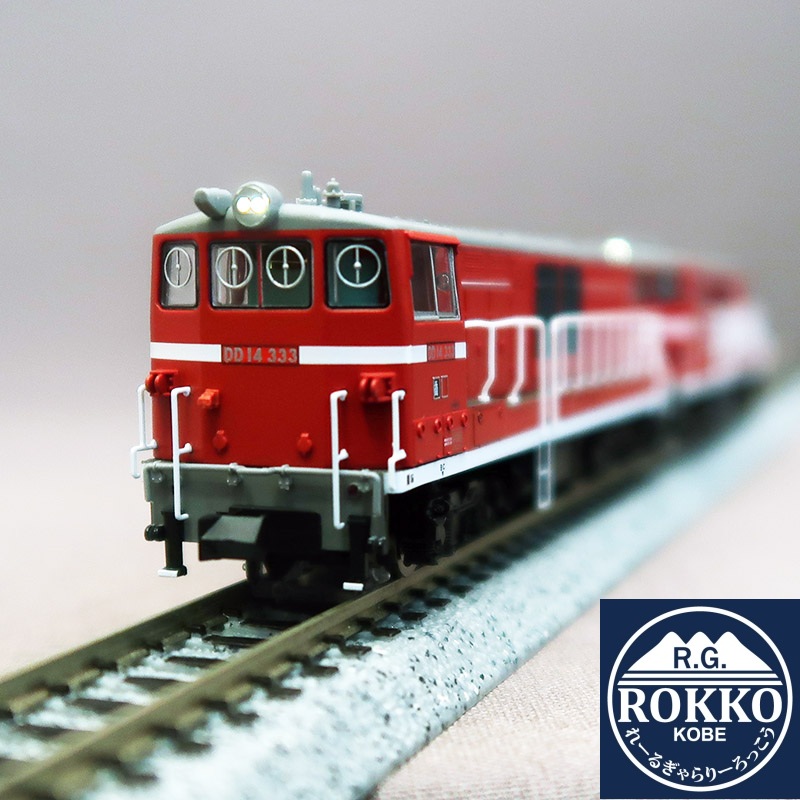
(A8167) JR DD14-333 + 334 Standard Color (without rotary head) Double-headed set
¥20,995JPY
SKU: MicroAce A8167
Package Volume: 400.00

ItemNumber A8167
JR DD14-333 + 334 Standard Color (without rotary head) Double-headed set
2 Cars Set
information
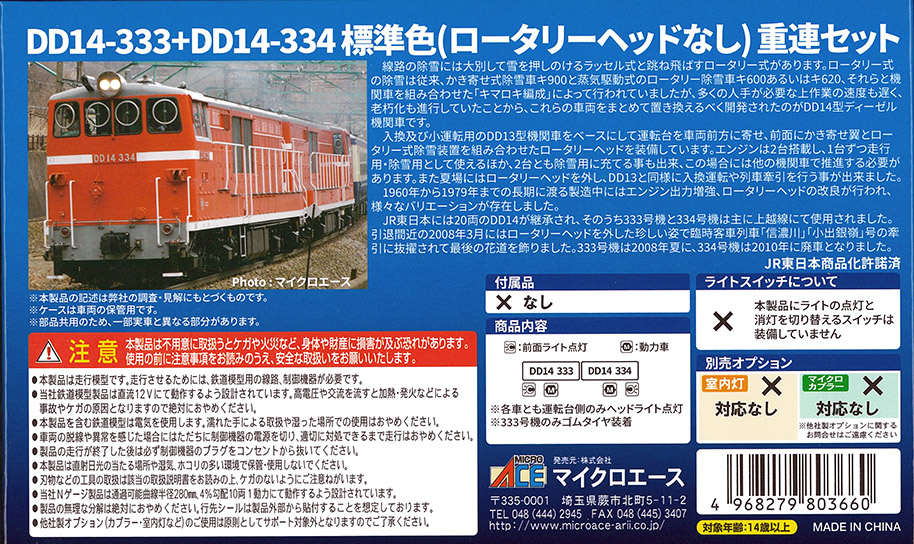
There are two main types of snow removal methods for railway tracks: the Russell method, which pushes the snow aside, and the rotary method, which throws the snow away. Traditionally, rotary snow removal was carried out using the Ki900 snowplow, the Ki600 and Ki620 steam-driven rotary snowplows, and a "Ki-Maro-Ki formation" which combined these with a locomotive. However, this required a lot of manpower, was slow, and the vehicles were aging, so the DD14 diesel locomotive was developed to replace them all. Based on the DD13 locomotive used for shunting and short-distance operations, the driver's cab was moved to the front of the vehicle, and a rotary head, which combined a snowplow wing and a rotary snow removal device, was equipped on the front. It was equipped with two engines, which could be used for both propulsion and snow removal, or both could be used for snow removal. In the case of snow removal, it needed to be pushed by another locomotive. Also, in the summer, the rotary head could be removed, and it could perform shunting operations and train towing operations similar to the DD13. During its long manufacturing period from 1960 to 1979, the DD14 underwent various modifications, including increased engine output and rotary head modifications, resulting in a variety of variations. JR East inherited 20 DD14s, of which DD14-333 and 334 were mainly used on the Joetsu Line. In March 2008, shortly before its retirement, it was chosen to pull the special passenger trains "Shinanogawa" and "Koide Ginrei" in a rare appearance with its rotary head removed, giving it a fitting farewell. Subsequently, DD14-333 was scrapped in the summer of 2008, and DD14-334 was scrapped in 2010.
JR DD14-333 + 334 Standard Color (without rotary head) Double-headed set
2 Cars Set
information
There are two main types of snow removal methods for railway tracks: the Russell method, which pushes the snow aside, and the rotary method, which throws the snow away. Traditionally, rotary snow removal was carried out using the Ki900 snowplow, the Ki600 and Ki620 steam-driven rotary snowplows, and a "Ki-Maro-Ki formation" which combined these with a locomotive. However, this required a lot of manpower, was slow, and the vehicles were aging, so the DD14 diesel locomotive was developed to replace them all. Based on the DD13 locomotive used for shunting and short-distance operations, the driver's cab was moved to the front of the vehicle, and a rotary head, which combined a snowplow wing and a rotary snow removal device, was equipped on the front. It was equipped with two engines, which could be used for both propulsion and snow removal, or both could be used for snow removal. In the case of snow removal, it needed to be pushed by another locomotive. Also, in the summer, the rotary head could be removed, and it could perform shunting operations and train towing operations similar to the DD13. During its long manufacturing period from 1960 to 1979, the DD14 underwent various modifications, including increased engine output and rotary head modifications, resulting in a variety of variations. JR East inherited 20 DD14s, of which DD14-333 and 334 were mainly used on the Joetsu Line. In March 2008, shortly before its retirement, it was chosen to pull the special passenger trains "Shinanogawa" and "Koide Ginrei" in a rare appearance with its rotary head removed, giving it a fitting farewell. Subsequently, DD14-333 was scrapped in the summer of 2008, and DD14-334 was scrapped in 2010.