(A8561) JNR Marone 40-12 (light green stripe, Miyahara Passenger Car Depot)
¥4,675JPY
SKU: MicroAce A8561
Package Volume: 220.00

ItemNumber A8561
JNR Marone 40-12 (light green stripe, Miyahara Passenger Car Depot)
Information
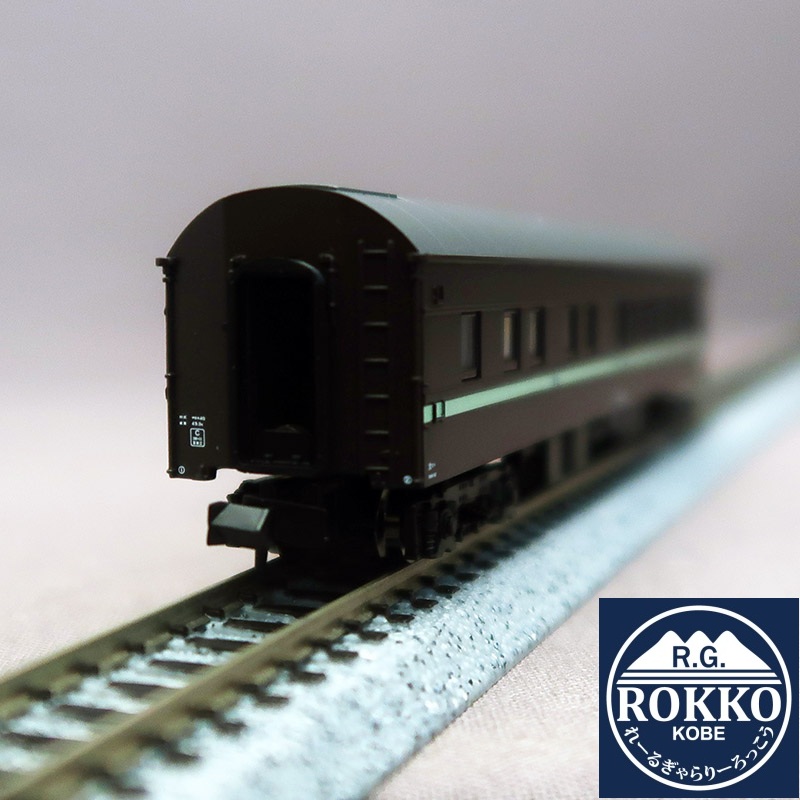
The Mine 40 series, consisting of 21 cars, was the first newly built sleeping car after the war, completed in 1948. It was part of the general-purpose conversion of newly built vehicles based on the demands of the occupying forces. It boasted the most luxurious amenities of the Japanese National Railways at the time, including both private compartments and Pullman-style (open-plan) berths, as well as air conditioning. However, it also featured rational design elements such as a steel plate roof with no tapering at the ends and the adoption of two-axle bogies. Initially, it debuted as a first-class sleeping car with entrance platforms at both ends, painted in grape color No. 1 with cream No. 2 stripes. After undergoing changes such as the removal of one entrance platform, a downgrade in class, and a change in designation, it consistently served as a frontline vehicle on overnight express trains on the Tokaido and Sanyo Main Lines, as well as sleeper express trains bound for Kyushu, until its retirement in the late 1960s. The product recreates the appearance of the Marone 40 in the 1960s, after the abolition of the three-class system, with its grape-colored No. 2 body paint, light green class stripe, and berth markings. It played a central role in overnight express trains alongside the 20 series sleeper cars during the golden age of the Japanese National Railways' conventional lines. Perhaps due to the increased surplus in rolling stock, trains such as the overnight express trains "Gekko" and "Myojo" on the Tokaido Main Line appeared with multiple Marone 40 cars coupled together, and records remain of its glorious service befitting a luxury sleeper car.
JNR Marone 40-12 (light green stripe, Miyahara Passenger Car Depot)
Information
The Mine 40 series, consisting of 21 cars, was the first newly built sleeping car after the war, completed in 1948. It was part of the general-purpose conversion of newly built vehicles based on the demands of the occupying forces. It boasted the most luxurious amenities of the Japanese National Railways at the time, including both private compartments and Pullman-style (open-plan) berths, as well as air conditioning. However, it also featured rational design elements such as a steel plate roof with no tapering at the ends and the adoption of two-axle bogies. Initially, it debuted as a first-class sleeping car with entrance platforms at both ends, painted in grape color No. 1 with cream No. 2 stripes. After undergoing changes such as the removal of one entrance platform, a downgrade in class, and a change in designation, it consistently served as a frontline vehicle on overnight express trains on the Tokaido and Sanyo Main Lines, as well as sleeper express trains bound for Kyushu, until its retirement in the late 1960s. The product recreates the appearance of the Marone 40 in the 1960s, after the abolition of the three-class system, with its grape-colored No. 2 body paint, light green class stripe, and berth markings. It played a central role in overnight express trains alongside the 20 series sleeper cars during the golden age of the Japanese National Railways' conventional lines. Perhaps due to the increased surplus in rolling stock, trains such as the overnight express trains "Gekko" and "Myojo" on the Tokaido Main Line appeared with multiple Marone 40 cars coupled together, and records remain of its glorious service befitting a luxury sleeper car.